One thing I learned very quickly as a kindergarten teacher is that children come to us with very different abilities to handle frustration, wait their turn, shift from one activity to another, or calm themselves when something doesn’t go the way they expected. And even the same child can have a completely different day depending on how tired they are, what happened before they got to school, or simply how overwhelmed they are feeling that day.
That is why teaching self regulation has to be more than telling a child to “calm down” or “make a better choice.” Young children need us to help them recognize what they are feeling, notice what is happening with their body and behavior, and practice strategies they can actually use when they need them.
Since I have always used the bucket filler concept with my students to teach kindness and classroom community, I started thinking about how that same familiar bucket visual could also help children understand and care for their own bucket. Before children can consistently fill the buckets of others, they also need help learning how to recognize what their own bucket needs and what they can do to help steady it.
That became the basis for these self regulation activities.
If you are new to bucket filling, you can learn more about it and see the bucket filler activities, books, visual demonstrations, and classroom community ideas I have used with my students here.
The basic idea behind these activities is simple:
How am I feeling? → What might my bucket be doing? → What could help me right now?
Using Bucket Filler Visuals to Help Young Children Understand Self Regulation
Because I work with young students, I like to make abstract concepts as visual and concrete as possible. That is one reason the bucket filler idea works so well.
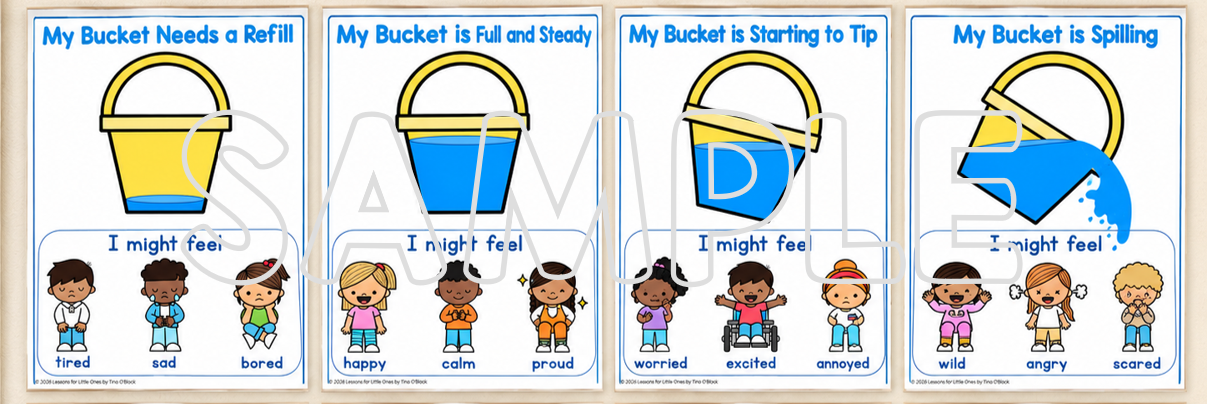
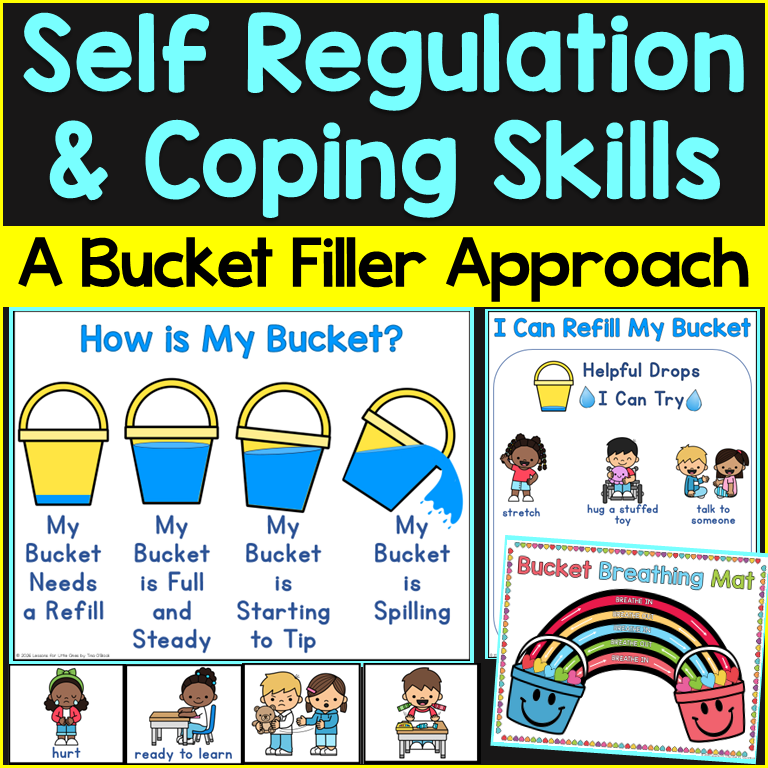
I use four different bucket conditions:
My Bucket Needs a Refill
This bucket has very little water in it.
A child whose bucket needs a refill may be feeling tired, sad, bored, hurt, or simply in need of a little connection or encouragement.
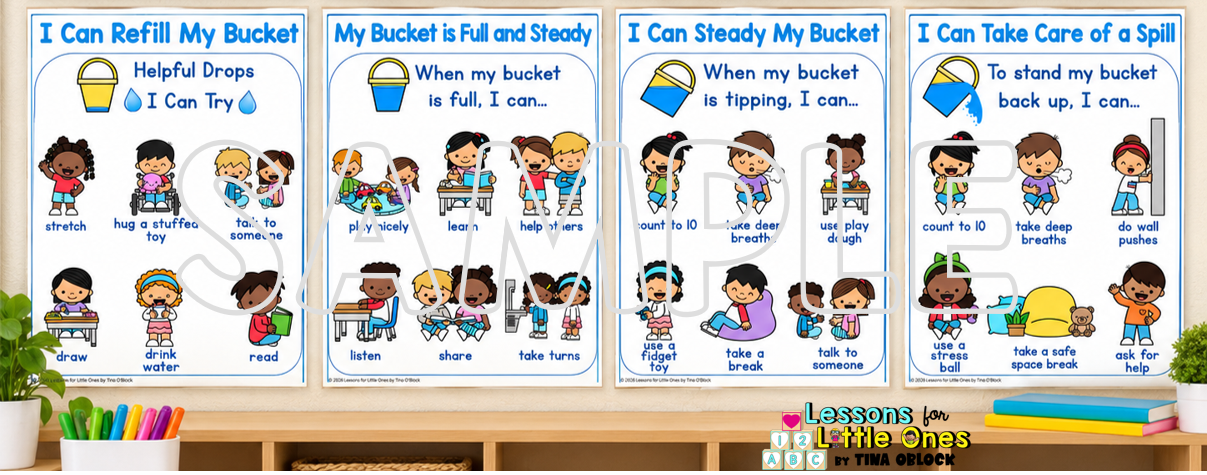
We talk about Helpful Drops (strategies) that may refill their bucket, such as stretching, talking to someone, drawing, drinking some water, reading, or hugging a stuffed animal.
My Bucket Is Full and Steady
This bucket is comfortably full and sitting upright.
Students might feel happy, calm, proud, or ready to learn.
This is also a good time to talk about all of the positive things we can do when our bucket is full and steady, such as learning, listening, sharing, taking turns, helping others, and playing nicely.
My Bucket Is Starting to Tip
The water is still inside the bucket, but the bucket is beginning to tilt.
This is the important early-warning stage.
A child might notice that a feeling is getting stronger, that their body is getting wiggly, that they are talking louder, moving faster, or having a harder time waiting or listening.
This is a great time to try a coping strategy before the bucket spills.
My Bucket Is Spilling
When the bucket tips far enough that the water begins spilling out, the child may be overwhelmed or having difficulty staying in control of their body and actions.
At this point, children may need more support from an adult along with strategies they have already practiced.
One thing I think is very important is that these are not rigid feeling categories.
I do not want students learning that “angry means your bucket is spilling” or “excited means your bucket is tipping.”
A child can be excited about a class activity and still be sitting, listening, and completely steady. That same excitement might begin tipping or spilling the bucket if the child starts yelling, running around the classroom, or having difficulty listening.
The bucket visual helps us talk about more than just the name of the feeling. We can also talk about how strong the feeling is, what is happening, and what the child’s body is doing.
Practice Recognizing Feelings
After introducing the four bucket conditions, I like to give students plenty of opportunities to talk about feelings.
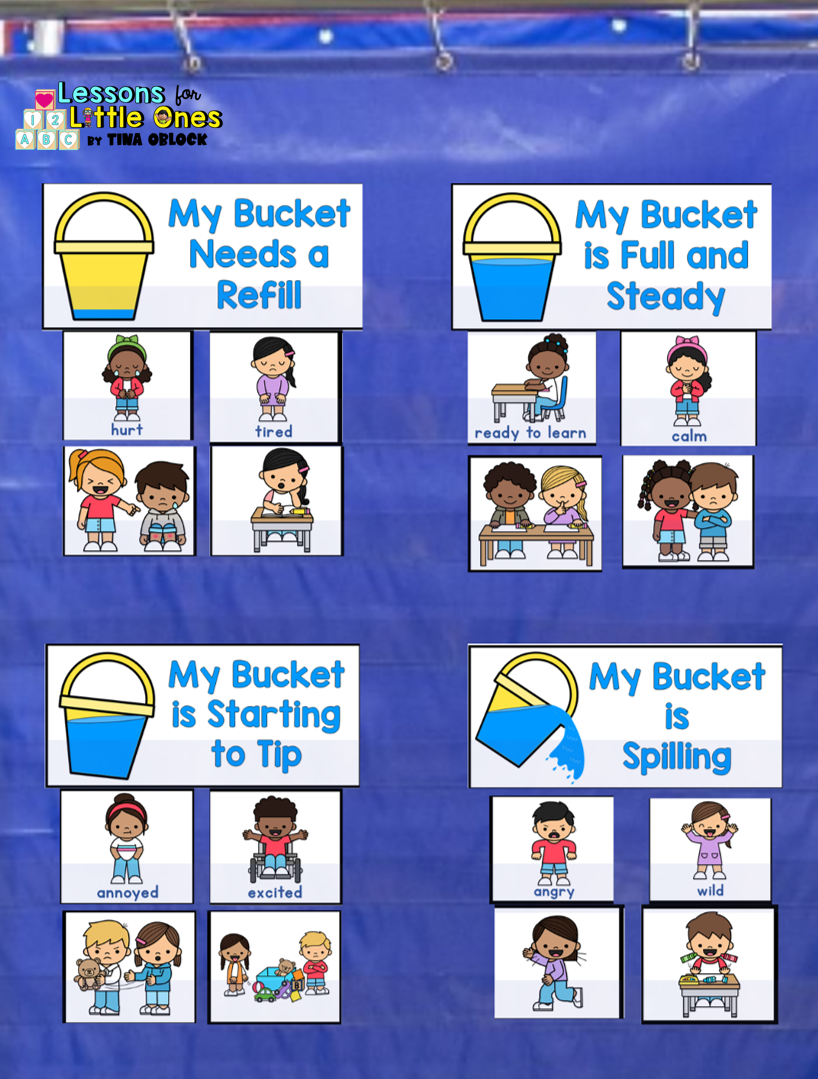
I use bucket headers in a pocket chart along with emotion cards and scenario cards.
We talk about what the child in the picture might be feeling and where we might place the card.
For some cards, there may be more than one reasonable answer.
That is actually a good thing!
It gives you the opportunity to ask questions such as:
- What do you notice about the child?
- What might have happened?
- Is the child’s body still in control?
- Is the feeling getting stronger?
This keeps the activity from becoming a simple matching game and helps children begin thinking about their feelings in context.
Use Real-Life Scenarios to Talk About Regulation
Scenario cards are another way I like to practice the concept.
The situations are based on things young children actually experience at school.
For example:
A child is excited about an activity but is sitting and listening.
Their bucket can still be Full and Steady.
Now change one part of the story.
The child is so excited that they are yelling, getting out of their seat, and having trouble listening.
Now the bucket may be Starting to Tip.
You can do the same thing with anger.
A child can be angry but still use words or ask an adult for help. Another child may be so overwhelmed by anger that they begin throwing, hitting, or kicking.
The feeling itself is not what determines the bucket condition.
I like changing one detail in a scenario and asking students, “Does that change what the bucket might be doing?”
This leads to some really good discussions.
Bucket Feelings Sorting Activities
After we have practiced the concept together, I use cut-and-paste sorting activities to check individual understanding.
Students cut apart the feeling pictures and decide which bucket condition they think each picture best represents.
I would use these after whole-group or small-group instruction rather than as the first introduction to the concept.

Just like with the pocket chart activities, I remind students that feelings do not always fit into one perfect category. The goal is to get them thinking about what might be happening and why.
Teach Coping Skills While Students Are Calm
One of the biggest things I want students to understand is that there are things they can try when their bucket needs help.
I use visual strategy posters and cards to introduce a variety of coping skills and calming strategies.
Some of the strategies include:
- taking deep breaths
- counting
- stretching
- using play dough
- using a fidget
- doing wall pushes
- squeezing a stress ball
- taking a break
- drawing or coloring
- reading
- talking to someone
- asking for help
I like to actually practice the strategies with students while they are calm.
It is much easier for children to use a strategy during a difficult moment if it is something they have already seen and practiced.
It is also important for students to learn that the same strategy does not work for everyone.
One child may love deep breathing while another responds better to movement. Some children may want a quiet break while others need to talk to someone.
The goal is for children to begin discovering, with our help, which strategies work best for them.
Personal Self Regulation Check-Ins
Once students understand the buckets and have practiced some strategies, I introduce a simple self-check-in.
Students first answer:
How is my bucket right now?
Then:
What could help me right now?
They can circle their bucket condition and choose one or two coping strategies they might try. I laminate them and have students use dry-erase markers. That way, as their feelings change throughout the day, they can simply wipe and reuse.

I like these because they put the pieces we have been practicing together in one place.
Instead of an adult immediately telling a child what to do, we can begin helping the child pause, notice what is happening, and think about what might help.
Young children will still need adult support, especially when they are very upset. Self regulation develops over time. These check-ins are simply another tool for helping them begin to build that awareness and independence.
Calm Down Corner or Quiet Regulation Space
I also like having these visuals available in a calm down corner or quiet regulation space so students have a familiar place to go when they need a little help getting their bucket steady again.
The Calm Down Corner sign keeps the bucket theme consistent with the rest of the activities. Since students have already learned to think about what their bucket may be doing, seeing the buckets and rainbow again helps reinforce that same idea in the space.
I also use a choice board so students can see a few simple strategies they can choose from. I think it is important for the choices on the board to match the materials and tools you actually have available in your classroom. If you have Play-Doh, a stress ball, books, drawing materials, or stuffed animals in your calm down area, those are the choices I would show. That way students are choosing from real options they can actually use.

Another visual I like to include is the Bucket Breathing Mat. I would introduce and practice this with students while they are calm so they already understand how to use it before they really need it.
Students can slowly trace along the rainbow from one bucket to the other, following the BREATHE IN and BREATHE OUT prompts as they go. The goal is simply to help them slow down and focus on a few comfortable breaths. I would not encourage children to take huge or forced breaths, just slow, natural breathing as they follow the path.

Just like the other coping strategies, the breathing mat will not be the best choice for every child every time. It is simply one more tool students can practice and learn to use when it helps them.
And I would keep the calm down corner as a supportive space, not a punishment or time-out area. Young children are still learning how to regulate, and there will absolutely be times when they need an adult to sit with them, help them calm their body, or practice a familiar strategy together. The visuals are there to support that process, not replace it.
Connecting Self Regulation and Bucket Filling
This is the part I really love about using the bucket concept for both.
Traditional bucket filling helps children think about how their words and actions affect other people.
These self regulation activities help them think about what is happening inside their own bucket.
The two ideas work together.
When children begin learning how to recognize their own feelings and get the support or coping tools they need, they are better prepared to learn, participate, solve problems, and make choices that fill the buckets of others.
If you are already using bucket filling in your classroom, this gives you a natural way to extend that familiar concept into self regulation and coping skills.
You can see all of my original Bucket Filler classroom community activities here.
And if you would like to use the self regulation posters, feeling cards, scenario cards, sorts, coping strategy visuals, check-ins, breathing mat, and calm down corner tools shown in this post, CLICK HERE TO SEE THE SELF REGULATION & COPING SKILLS RESOURCE.
If you would like both sets of activities, I also bundled the complete Bucket Filler resource with the Self Regulation & Coping Skills resource in a MONEY-SAVING BUNDLE: