One of my favorite read-alouds for back-to-school is Our Class is a Family by Shannon Olsen. I love how she connects the familiar concept of family to students’ new class. It’s such a sweet way to convey to your new students from day one that their new classroom is a place where they can feel safe, cared for, and included.
Since young children often need more than one discussion to truly understand what it means to be part of a class family, I created a variety of Our Class is a Family book activities to help preschool, kindergarten, and first grade students understand what belonging to a classroom community looks and feels like.
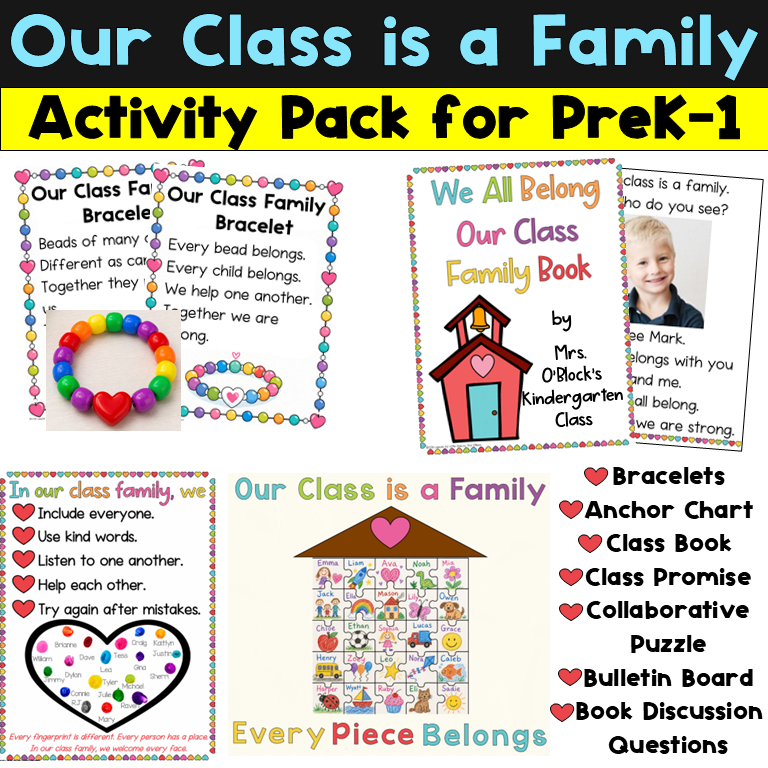
These activities give students several meaningful ways to explore what it means to be part of a class family. They create a class family bracelet, work together on a collaborative puzzle, and help make a class book while practicing kindness, inclusion, and connection. The anchor chart, class family promise poster, and coordinating bulletin board also provide visual reminders you can return to throughout the year.
If you would like to use them in your classroom and save prep time, all of the materials and detailed directions are available in my Our Class Is a Family Activities resource. Below, I’ll walk you through each activity and explain how it helps students feel connected, included, and valued in their new class family.
Book Discussion and Anchor Chart / Pocket Chart Activity
Prior to reading the book, I like to show students the title and cover. We discuss what they think of when they hear the word family. Then, we talk about what they think the book will be about.
As you read the book, pause when appropriate to help your students connect the ideas in the story to your own classroom. Encourage them to share examples, act out simple situations, or explain what a caring classmate might do.
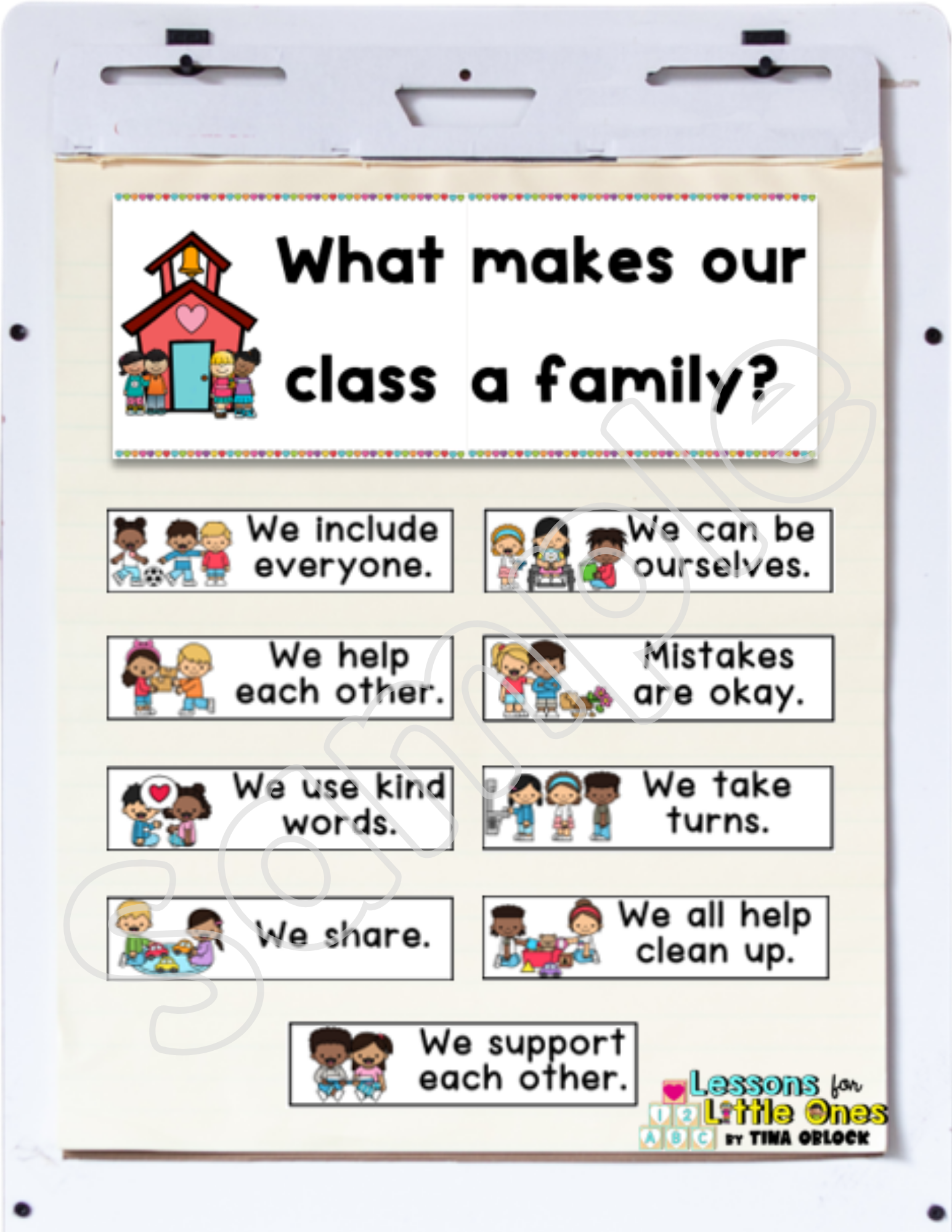
This anchor chart activity will further help students relate the concepts from the book to their own classroom by having them answer the question “What makes our class feel like a family?”
Help your students identify the actions and behaviors that make a classroom feel safe, welcoming, and caring. You can use premade pictures and have students say what they think is happening or write your own ideas from your students’ responses.
Class Family Promise Poster
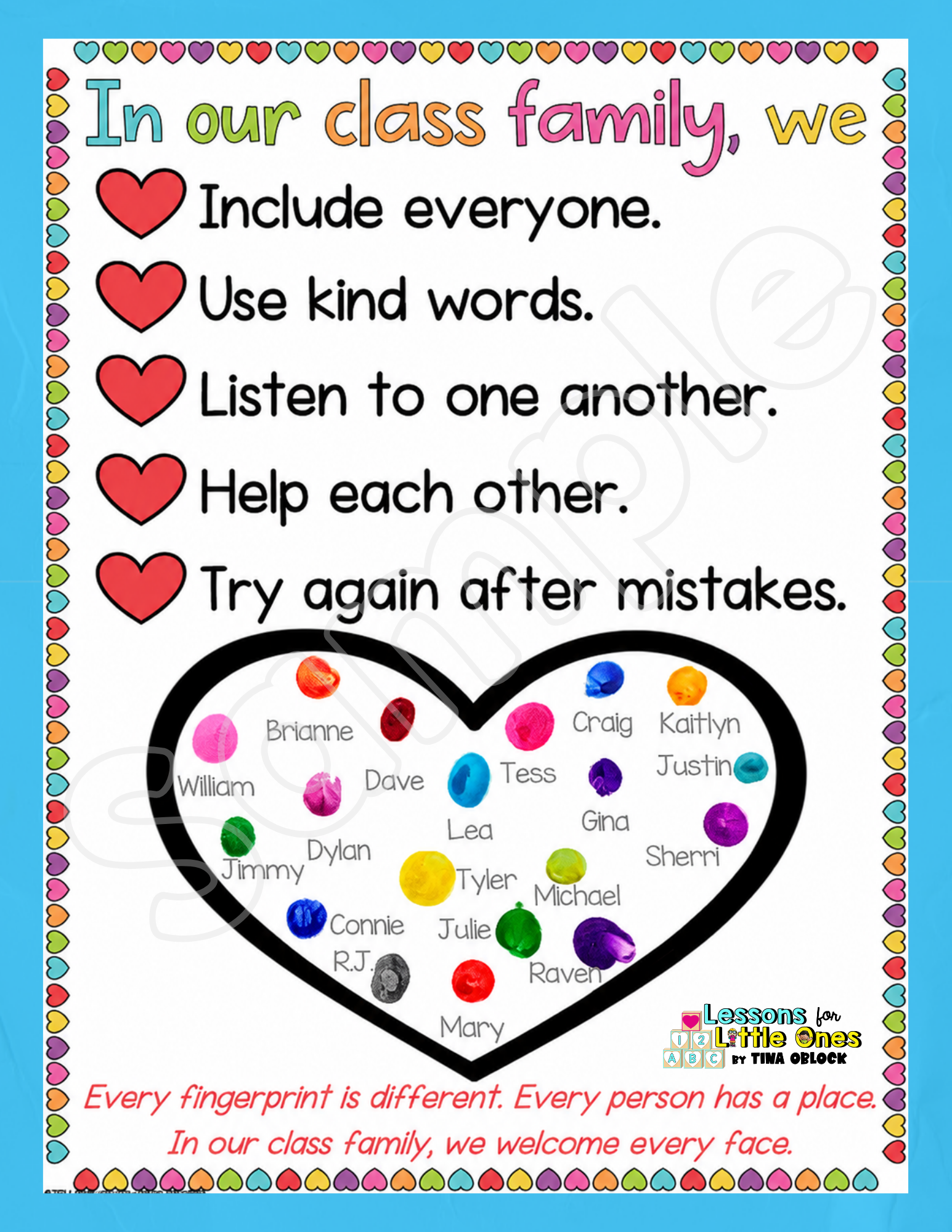
After doing the pocket chart activity, decide as a class which ideas are most important. Put the top 5 on a Class Family Promise Poster.
Place a large heart underneath the promises, and have each student add a fingerprint to it to show that the child is an important member of the class family and will try to follow the promise. Their names can also be added if space allows.
Students really enjoy putting their fingerprints on the poster as their “signature” and promise! They also like looking closely at the fingerprints and noticing how each one is different (you can put magnifying glasses by the poster to help with this).
Before beginning, say something like: Every fingerprint is different, just like every person in our class is different. When we put our fingerprints together, they create our class-family heart. Your fingerprint shows that you belong here and that you will help us care for our class family.
Review the promise as well as the saying along the bottom: Every fingerprint is different. Every person has a place. In our class family, we welcome every face.
Display the completed promise where students can revisit it throughout the year.
Our Class Family Bracelet
These class family bracelets are a favorite! Students love making and wearing them! They are a personal reminder for each student that they are an important part of the class family.
Materials
- Beads in different colors
- Chenille stems, elastic cord, or lacing cord
- Optional heart-shaped beads
- Small trays, cups, or containers for organizing beads
- The bracelet chants and poems
Chenille stems are often easiest for young children to use because the firm ends make the beads easier to string. After students finish, fit the bracelet to each child’s wrist, twist the ends together securely, and tuck the ends into a bead so they do not scratch or snag. You may also use elastic cord or another bracelet material that works well for your students.


There are two bracelet options from which to choose, depending on the size of your class.
Option 1: One Bead for Every Class Member
Each student adds one bead to represent every child in the class. This option works especially well with smaller classes.
Before beginning, say something like:
Each bead on your bracelet will represent someone in our class family. Every bead is important because every person in our class is important. When you look at your bracelet, it can remind you that you belong here and that all of your classmates belong here too.
Depending on the age of your students, you may:
- Count the beads together as a class.
- Place the correct number of beads in a cup for each student.
- Allow students to add one bead as each classmate’s name is called.
Option 2: Our Class Family Colors
Begin by showing students the bead colors that are available. Invite each child to choose a favorite color from that selection.
Record the children’s choices. The colors selected by the class become the class-family colors. Students then use those shared colors to create their bracelets. For a class with many students, you do not need to include one bead for every child. Use each different color chosen by the class to create a color group or repeating pattern.
You may:
- Create one class pattern for everyone to follow.
- Allow students to arrange the class-family colors in their own patterns.
- Repeat the colors until each bracelet is long enough.
- Add an optional heart bead to represent belonging.
Afterward, compare the finished bracelets. Point out that they may look alike in some ways and different in others, just like the members of the class.
Say something like:
Our bracelets are not all exactly the same, and neither are we. We are each different, but we all belong to the same class family.
Reinforce the Meaning with Poems and Chants
I like to use chants and poems to help remind young students of their bracelets’ meaning.
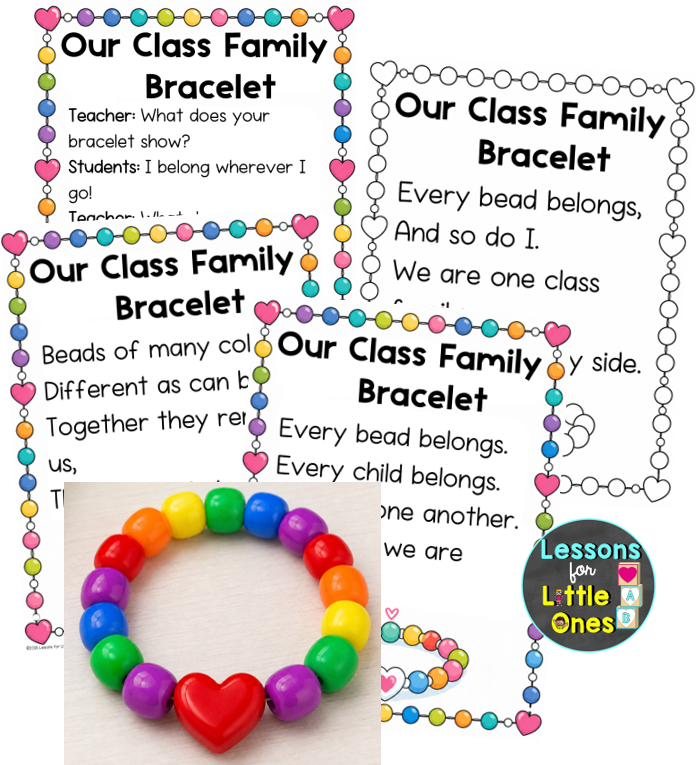
Encourage students to keep their bracelets as reminders of their class family. Revisit the bracelet saying or chant whenever the class is discussing friendship, inclusion, kindness, or belonging.
We All Belong Class Family Book
I wanted to create something that students would love coming back to again and again throughout the year. I decided on our own version of a class family book that includes each student’s photo and a class photo (family photo).
It uses predictable text so young students can read it independently. Since each child in the class has their own page, it also helps students learn each other’s names at the beginning of the year.
The book reinforces the message that each child is unique and their own person, and they all belong to the class family (together they create a strong family bond).
It is very easy to create in PowerPoint using image placeholders!

This book quickly became a student favorite because they could “read” it on their own! They LOVED seeing their pictures, and it really helped them learn their classmates’ names.
Our Class is a Family Collaborative Puzzle
This collaborative activity gives each child a special part in creating a class-family display. Each student decorates one puzzle piece, and the pieces are assembled into a schoolhouse to show that every child belongs in the class family.
The completed schoolhouse puzzle makes a meaningful display for the beginning of the year and can remain up as a reminder that every person has a place in your classroom.
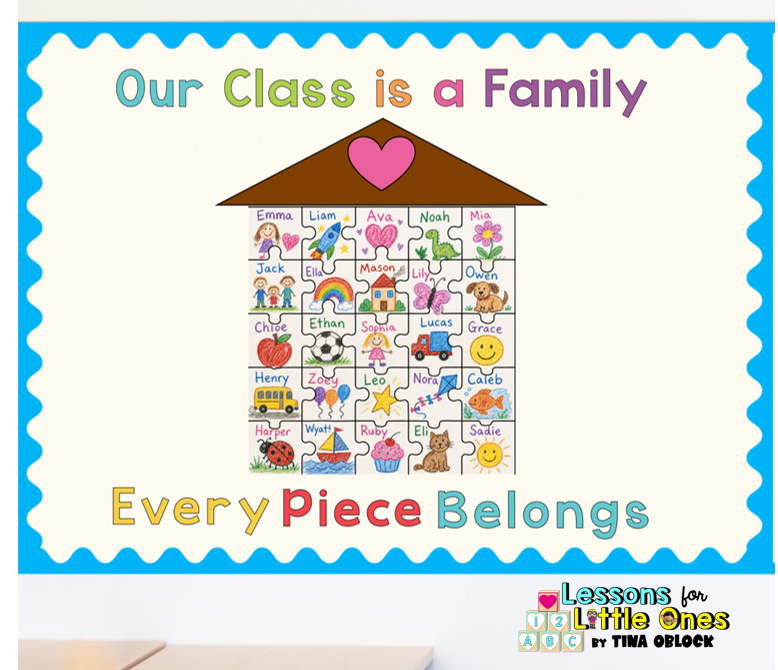
Gather students around the completed schoolhouse and say something like:
Look at what we created together. Every puzzle piece is different, but all of the pieces fit together to make one class schoolhouse. Each piece has an important place in our puzzle, and every person has an important place in our class family.
This really helped introduce how to work together as a team, and students were excited to see the finished schoolhouse. They proudly pointed out which piece was theirs.
Class Family Bulletin Board
This display lets students create a bulletin board together that serves as a visual reminder that they are a class family.
I loved the “home sweet classroom” sign in the book and the idea of making the classroom a home away from home, so I created picture frames for the students to draw a picture of themselves and write their name (a simple enough craft for young learners at the beginning of the year). Then I created a class display by hanging their pictures around the sign to resemble family photos hanging on a wall.

I have also done a version where students draw and write on a schoolhouse about how they can help make their classroom feel more like a home. This is best for students in first grade or older who already know how to write at the beginning of the year.

If you would like to use these ideas with your students and save prep time, the printable patterns, detailed step-by-step instructions, bulletin board letters, and editable class book are included in my Our Class is a Family Activity Pack available here.