Most young children can not sit still for long periods of time. They are active learners who need to move! In this post I’m sharing how movement can be part of learning, not a break from learning.
Our brains are incredible organs, but they are limited in how much they can stay focused and motivated. Adding movement to lessons supports the conditions students need to create more oxygen and blood flow to the brain for it to function optimally. Studies have shown that physical activity (even small movements) improves students’ focus, retention, memory, creativity, and mood.
With the increasing educational demands and decreasing recess or free play times, young students are not able to move about freely during the school day as much as they should. When students start shifting around on the carpet or getting restless during a lesson, they may need an opportunity to get up and move.
But with so many standards to cover and skills to practice, fitting everything into the school day can feel overwhelming. We know our students need movement, yet we also need time for reading and math instruction.
That’s why I created Brain Building Brain Breaks that let students move while learning! Students answer questions by doing specific movements, giving them a break from sitting while they practice reading and math skills. To know which movement to do, they first have to think about the question and choose their answer.
They are using purposeful movements to help them learn and practice math and literacy standards. Using purposeful movements during a lesson enhances students’ retention and makes learning more fun!
These multi-sensory Brain Building Brain Breaks help students learn reading and math skills while having fun!
Adding Movement to Classroom Learning
Movement can do more than give students a chance to stretch. The CDC identifies classroom physical activity as a way to support students’ concentration, ability to stay on task, and motivation to participate in learning. It can include both movement breaks and physical activity incorporated into academic lessons.
With these activities, students show their answers through movement instead of just saying or selecting a response. The movement serves a purpose: it tells you which answer they chose.
These activities also help with following directions and focus because students have to think about their answer and the movement associated with it. They can get up, participate, and continue working on a learning goal.
How the Math & Literacy Brain Building Brain Breaks Work
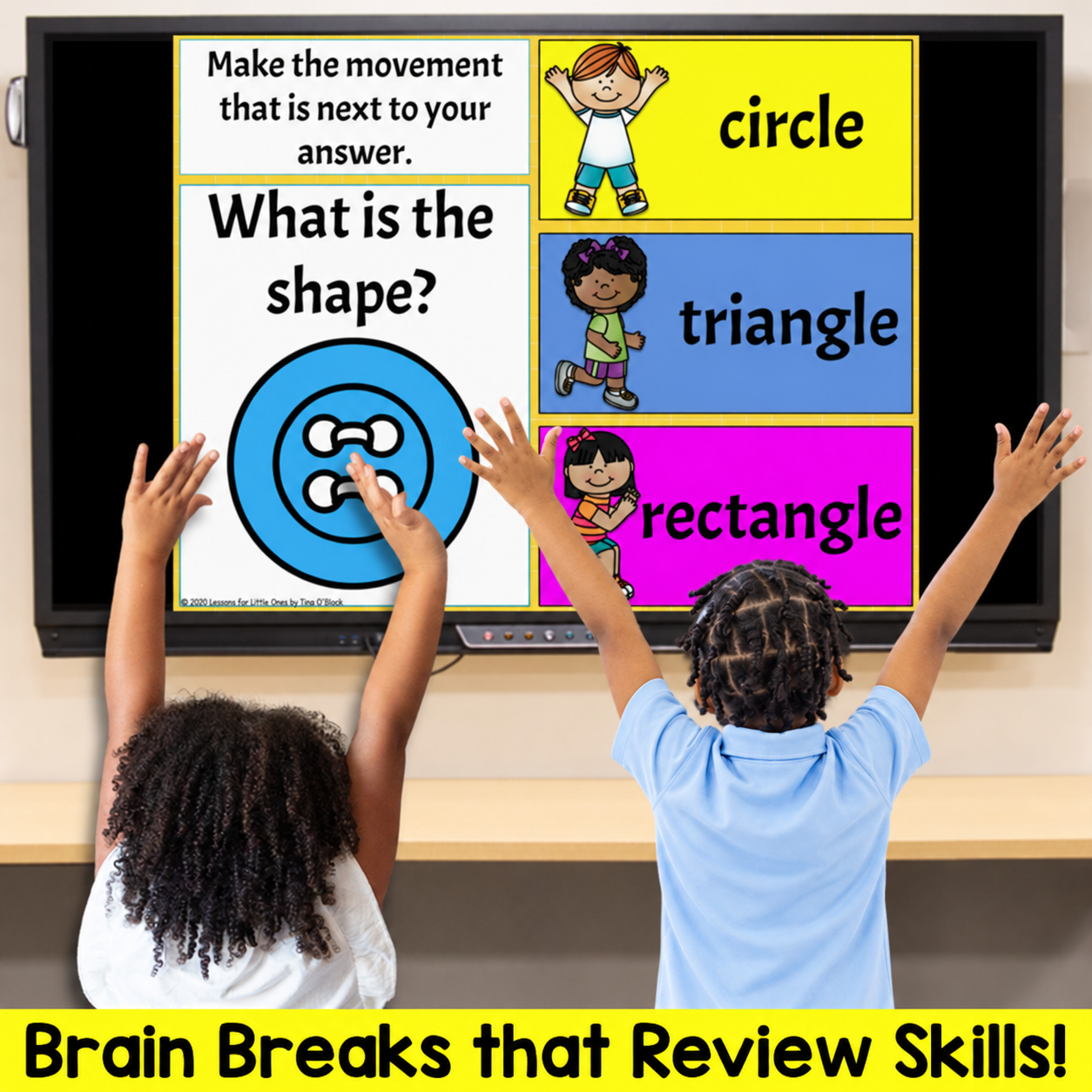
Each question slide has 3 answer choices with a picture of a child demonstrating a movement beside each one. Students choose their answer and do the matching exercise.
Introductory movement slides give you a chance to teach and practice the exercises before starting the questions, and the pictures beside the answers remind students what to do.
How to Use the Brain Break Activities with Your Class
The most common way to use these activities is with the whole class. Display the slides on your interactive whiteboard or classroom screen, and have students find a spot with enough room to move.
Introduce and Practice the Movements
Explain that students will show their answers by moving instead of calling them out.
Display the introductory movement slides and practice each exercise together. You can model the movements, talk about staying in your own space, and adapt an exercise for students who need a different way to participate.
Taking a little time to practice first helps students know what to do when the questions begin.


Show the Question and Explain the Choices
Read the question and point to the answer choices and their movements.
For a letter matching activity, you might say:
“If you think this is the matching lowercase letter, do arm circles. If you think it’s this one, march in place. If you think this one matches, touch your toes.”
The movement pictures stay on the screen so students can refer to them as they decide. Students can show an answer without needing to say it aloud, which also gives nonverbal students a way to respond.

Give Students Time to Think, Then Move
Give everyone a few moments to choose an answer before inviting the class to move. A simple cue such as “Think about your answer. Ready? Show me!” helps students respond together.
Students then do the movement beside their answer choice.
As they move, look around to see which responses they have chosen. You can notice who is answering correctly, who seems unsure, and which questions might need another explanation.
If a student appears to be following classmates, you can check that skill again in a small group. Their movement gives you useful information to follow up on.
Reveal the Correct Answer
Once students have responded, click the slide to reveal a green checkmark beside the correct answer.
You can pause to explain or discuss the answer, then invite everyone to do the matching movement together. For example, count the objects again, say the beginning sound, or reread the word before moving to the next question.
This answer reveal gives students immediate feedback.

Choose the Questions and Length of Practice
I wanted to be able to easily differentiate the activities and choose which slides to use and how many to do at one time. That’s why I created the activities in both Google Slides and PowerPoint.
You can rearrange the slides to focus on the skills your students need. Start with a few familiar questions, select slides that connect to your current lessons, or revisit questions that need more practice.
You don’t have to finish an entire set in one sitting! A few slides can fit between activities, at the beginning of a lesson, or whenever your students need a chance to move.
For a longer review, work through more questions and pause to discuss students’ thinking along the way.
They can be used for a fun introduction, practice, or review throughout the year!
Small Groups
You can also do the brain break activities with your small groups using a laptop or ipad. It is also an easy and fun activity for a parent volunteer to do with a group of students.

Virtual Learning or At-Home Activity
These brain break learning activities are perfect for virtual learning and can also be used in your computer centers or at home. Students can move through the slides, and since they are self-checking, they will know if they are correct.

What Educators are Saying About These Resources
Some teacher friends who have tried them said the following:
“My kindergartners LOVED this!! SO much fun – one of the best things I have bought on TPT” – Katie S.
“This is a great resource! These are fun to use as a quick lesson, or when the kids really just need a break! It is something fun for them to do, and it helps them get up and get moving!” – Stacey H.
“My students absolutely loved this activity! It is amazing for review and worked well with my intervention students. Thank you so much!” – Barbara K.
“Absolutely love using this interactive resource in my kindergarten and 1st grade classroom! Great way to get my students up and moving while practicing academic skills.” – Kathryne B.
“My students are loving this for review and it helps me quickly check where everyone is at.” – Shelby S.
“I try to include movement for my student to help with their focus. This activity provided movement and skill practice! It was perfect for my needs!” – Leslie W.
“I love this resource! Adding movement to the skill is an excellent way to get students excited and moving while being confined to one space.” – Bright Eyed in Elementary
Try a Free Counting to 10 Movement Activity
Try this way of practicing math with your class! In this free Counting to 10 activity, students count the objects in the ten frame, choose their answer, and do the movement beside it.
You can see how the routine works with your students while giving them a chance to get up and move during counting practice.
Download the Free Counting to 10 Activity
Find Movement Activities for the Skills You’re Teaching
Once your students know how to move to show their answers, you can use the same routine to practice other skills throughout the year.
Choose activities that match your current lessons, revisit skills that need more practice, or select a few questions for a quick review.
Literacy Skills
- alphabet letters (matching uppercase & lowercase letters)
- letter sounds, beginning sounds
- rhymes, rhyming words
- counting syllables
- colors, color words
- CVC words
- CVCe words
- CVCC words
- CCVC words
- consonant blends (L blends, R blends, S blends)
- beginning digraphs
- ending digraphs
Math Skills
Save with a Movement Activities Bundle
If you’d like movement activities for several skills, the bundles let you save compared with purchasing the included resources separately.
- Math and Literacy Movement Activities Bundle: Get both collections together at a discounted price so you can use the routine across reading and math.
- Math Movement Activities Bundle: Keep a variety of math activities ready for practice and review.
- Literacy Movement Activities Bundle: Add movement to your letter, sound, and word practice.
Choose the skills your students need, display a few slides, and let them move to show what they know!
Pin it for later!