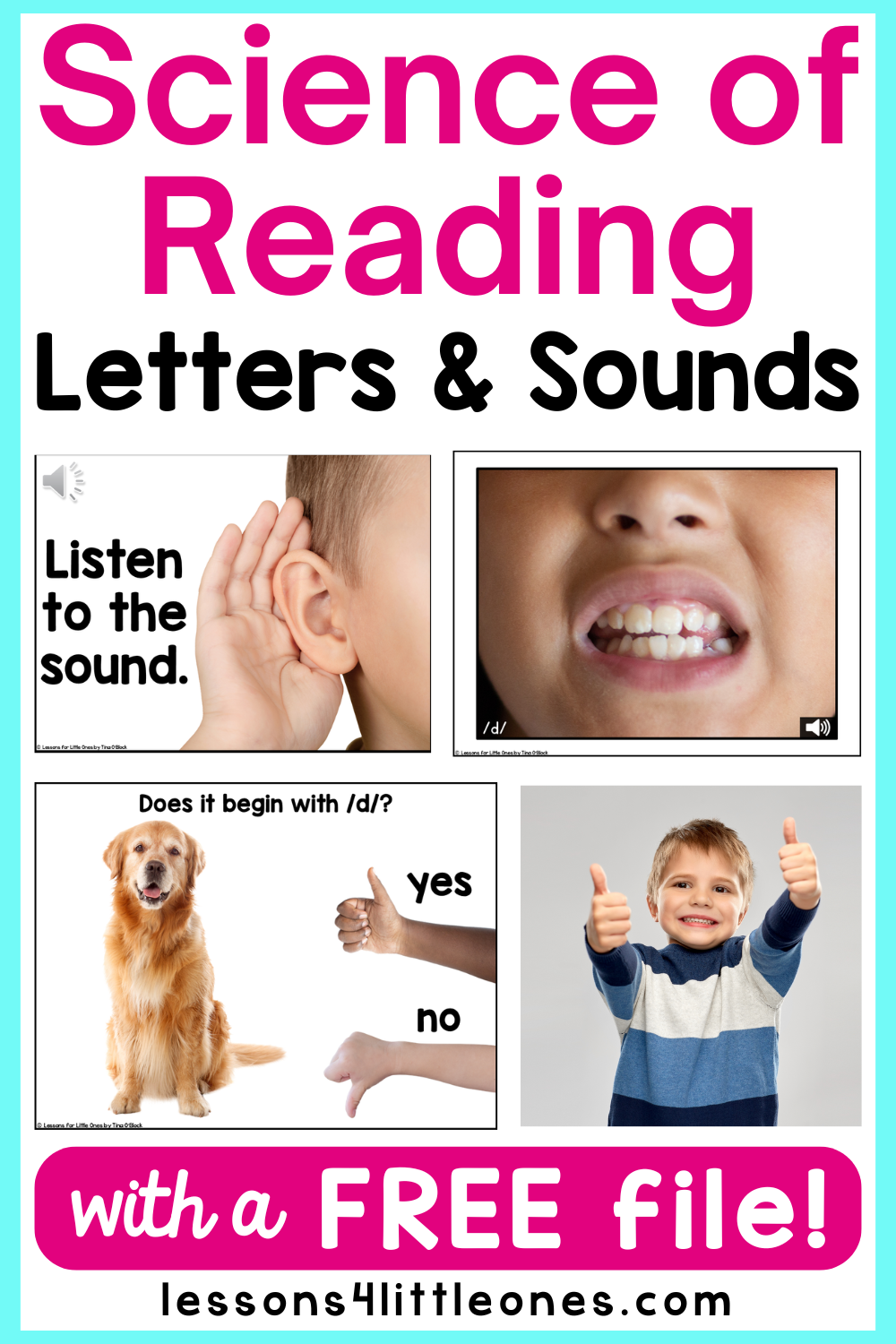
The alphabetic principle is a critical skill for young students to master. It involves connecting letters with their sounds in order to read and write. For students to become successful readers, they need to learn how to use the alphabetic principle fluently and automatically so they can focus their attention on understanding the meaning of the text, which is the primary purpose of reading.
Learning the alphabetic principle takes time and requires explicit phonics instruction and extensive practice. Luckily, the science of reading provides proven, evidence-based best practices for teaching reading and supporting students of all abilities. I will be sharing what I have learned to be the most effective practices for alphabet and phonics instruction (speech to print approach) along with a free file for you to try in your classroom.
Explicit and Systemic Instruction
It is important that our alphabet and phonics instruction is explicit and systemic. Explicit instruction means we directly teach letter-sound relationships. We tell students the letter sound and show how that sound is represented in print (speech to print approach).
Systemic instruction is when the introduction of the letter-sound relationship is organized into a logical, step-by-step instructional sequence.
I am going to share an instructional sequence for teaching the alphabet letters that is based on the science of reading research.
When teaching phonics lessons, I like to use digital slides projected on the board so all students can view them. It is easier than using multiple cards or pictures and I can easily reference where on the sound wall the featured sound is located, without having to remove the cards. It allows the pictures to be enlarged so that all students can view them easily.
I also like how low prep they are – show and go! Plus, learning the alphabetic principle takes extensive practice, I can easily use the slides multiple times throughout the year for review.
Use a Speech to Print, Sound First Approach
To me, this has been one of the biggest game-changers in alphabet and phonics instruction. Introducing the sound first before the letter has an incredible impact. By aligning with students’ existing knowledge of speech sounds, this approach allows them to connect what they already know to how sounds are represented in print. This, in turn, helps build the essential phoneme-grapheme correspondence crucial for decoding and reading words.
Introduce the sound to the students and have them repeat it. You can say the sound OR say words with the sound at the beginning and see if students can tell you the new sound. For example, you can say something like “Let’s see if you can tell me the new sound for our lesson today. Tell me the first sound you hear in duck, dog, dinosaur”.

Mouth Formation
Using mouth pictures as visual aids provides students with a clear understanding of how each sound is formed in the mouth.
Explicitly teaching and drawing attention to the mouth movements for each phoneme helps anchor the sounds into memory and enhances students’ ability to distinguish between letters that may look alike or sound similar. This method helps create a connection between what students are hearing and how the sounds feel in their mouths.
Using this multi-sensory approach has really helped students learn the sound-letter connection and better distinguish between similarly sounding letters.
When introducing a sound, show students the mouth picture and say the sound.

Then, have students say the sound while looking into mirrors to see what their mouths are doing. If you don’t have mirrors, students can use the camera on their iPads like a selfie and look at their mouths or turn to a partner and watch each other’s mouths.
Discuss what your tongue, lips, and teeth are doing when saying the sound, if the sound is voiced or unvoiced (place your hand on your throat to feel if it vibrates), and if the airflow is continuous (you can draw out the sound until you run out of breath) or a stop sound (has a quick stop after it is produced).
I like to ask probing questions to help call attention to the placement of their lips, tongue, and teeth:
- Is your tongue high, low, or pulled back?
- Feel your throat. Is your voice box on or off?
- Is anything blocking the airflow (lips, tongue, or teeth)?
- Is the airflow continuous or does it stop?
- When you make the sound, does the airflow come out of your mouth or nose?
- Are your lips open or closed?
Keyword Picture as a Memory Aid
Say the name of the keyword picture, using beginning sound isolation (pronounce the first phoneme in a word, then say the whole word). You can say something similar to “/d/, /d/, duck”. Have students repeat.
Explain that the sound is at the beginning of the keyword. Isolating the beginning sound helps students understand that words are made up of a series of sounds.

Matching Beginning Sounds
Now students are going to listen for the sound at the beginning of different words to practice beginning sound isolation and sound discrimination.
Show them pictures of objects. If the picture name begins with the sound, students show a “thumbs up”. If the picture name does not begin with the sound, they show a “thumbs down”.
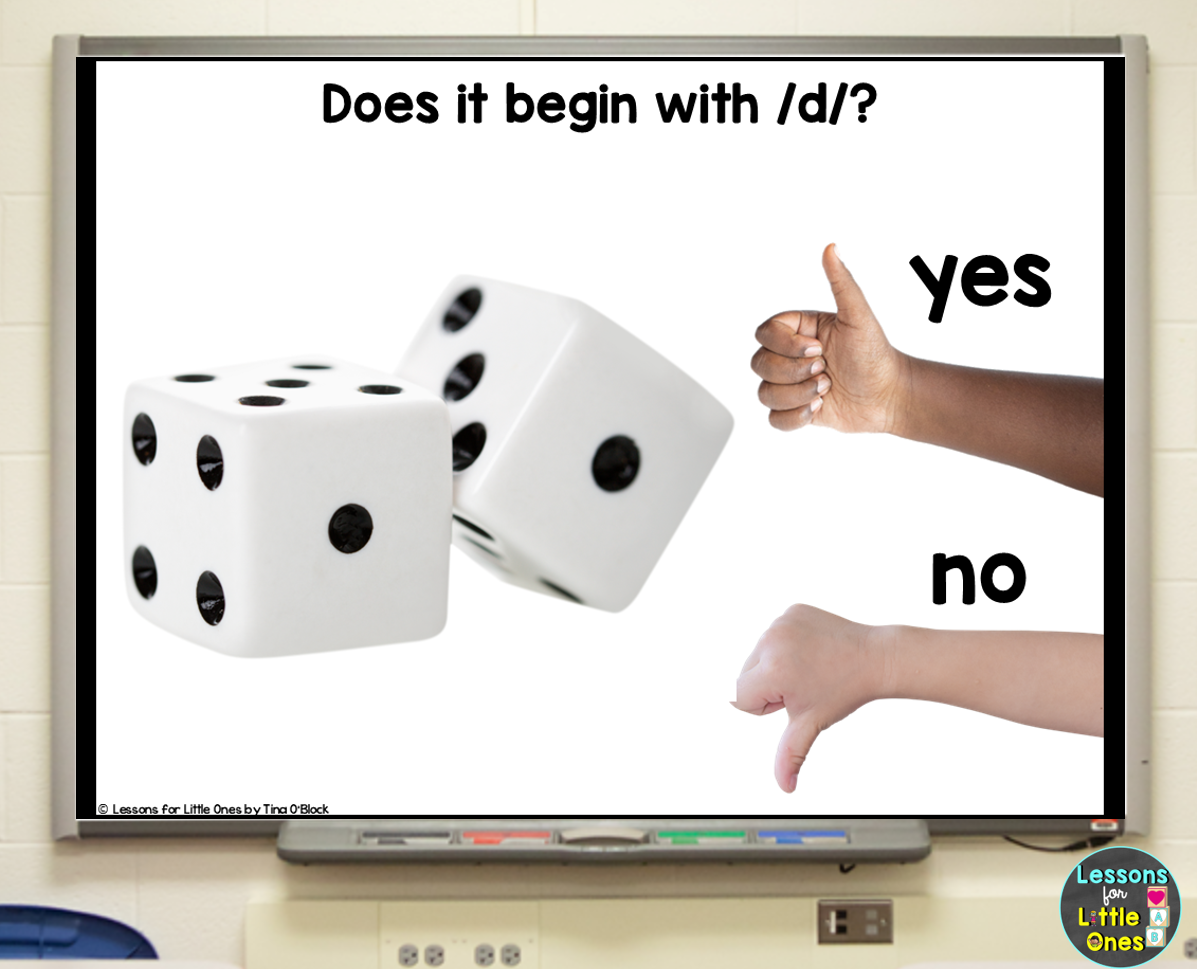
Students love being actively involved in the instruction! It keeps them engaged!

Show 4-5 different pictures and observe students’ responses.

Where in the Word Do You Hear the Sound?
Explain to students the sound can also be found in the middle and end of words, as well as the beginning, and they are now going to practice locating the sound in different words.
If they hear the sound at the beginning, they place both hands on their heads.
If they hear the sound in the middle, they place both hands on their hips.
If they hear the sound at the end, they touch their toes.
This helps students better discriminate the sound, segment sounds, and understand that words are made up of individual sounds.
Students LOVE doing these exercises! The movement helps keep them focused and interested!
Show 4-5 different pictures and have students do the appropriate movements to show where they hear the sound.

How the Sound is Represented in Print
Now that students are familiar with the sound, it is time to connect the phoneme (sound) to the grapheme (letter).
Tell students that the sound (say sound) is represented in print by (show the spelling). Point out the difference between the capital letter and the lowercase letter. Point to each letter and have students say the sound.
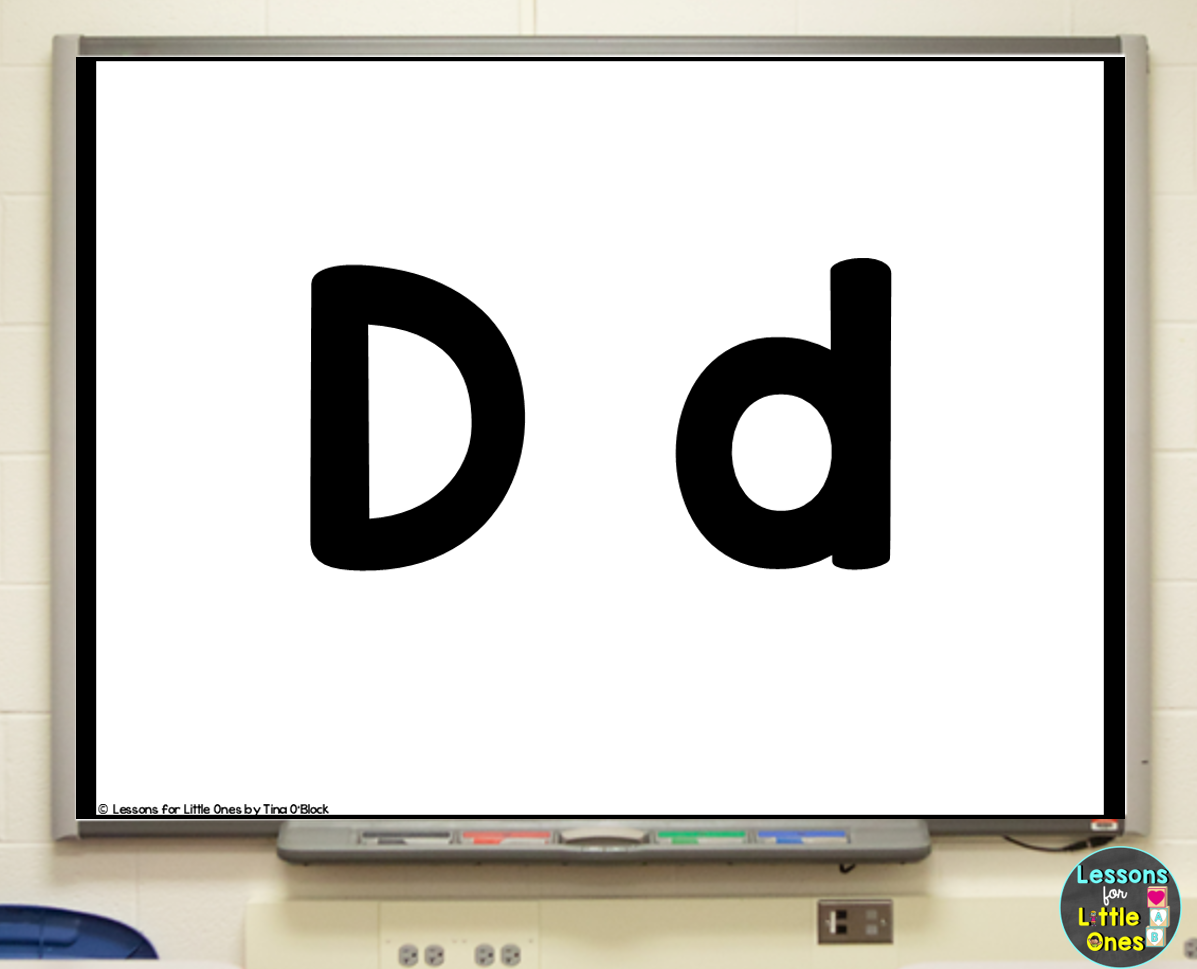
Letter Formation
Show and say the proper letter formation for each letter followed by the letter sound. For example, for capital D say something similar to “Down, around. /d/”.
I love using these animated gifs that show the proper letter formation! Students can clearly see how to form each letter.


Then, have students air write each letter and say the sound when they are finished. Doing the muscle movements and writing the letters leaves a muscle memory in the sensorimotor part of the brain which helps students recognize letters. It also helps children better recognize the unique properties of each letter

Extended Practice & Assessment
Since learning the alphabet and how to properly write letters takes extensive practice, I like to follow up instruction with a coordinating science of reading aligned alphabet page.
This phonics lesson follows the I Do – We Do – You Do format, and this gives students a chance to practice what they learned on their own. It is also an opportunity to assess their letter knowledge and handwriting skills.

Free Science of Reading Alphabet Slides & Page
If you would like to try this phonics lesson in your classroom, CLICK HERE to download my Free Letter Dd Alphabet Slides and Page.
Products Used in This Post
If you would like the entire set of science of reading alphabet slides and pages to use with your students, CLICK HERE to download them in a money-saving bundle!
Pin it for later!